

You've done your research, ordered your nattokinase supplement, and it's sitting on your kitchen counter — and now you're wondering: when exactly should I be taking this, and is there a best time to take nattokinase?
It's a question we hear all the time, and it's a smart one to ask. Nattokinase is a natural enzyme derived from natto — fermented soybeans that have been a staple of traditional Japanese diets for centuries. As interest in nattokinase UK supplements has grown in recent years, so has the curiosity around how to take it correctly.
Timing your supplement well can make a real difference to how effectively your body is able to use it. In this guide, we'll walk through what the research suggests, when most people find it works best, and how to build nattokinase into your daily routine with confidence.
What is nattokinase and how does it work in the body?
Nattokinase is a proteolytic enzyme — meaning it can break down proteins. It's produced during the fermentation of soybeans by the bacteria Bacillus subtilis natto, and has been studied for its potential role in supporting healthy blood flow and cardiovascular function.
Unlike many nutrients that are absorbed and stored, nattokinase is an active enzyme. Once consumed it works in the digestive tract and, according to research, may be partially absorbed into the bloodstream, where it is thought to support the body's natural fibrinolytic activity — the process the body uses to maintain healthy circulation.
This is important context for timing. Because nattokinase works as an enzyme rather than a nutrient, when you take it — in relation to food, time of day and other supplements — may influence how much reaches the bloodstream in its active form.
Does the time you take nattokinase actually matter?
In short — yes, it can. The enzyme's stability in the digestive system may be affected by the proteins and digestive acids released when you eat, and some research has explored how enzymes like nattokinase fare differently taken with food versus on an empty stomach.
Most practitioners suggest that taking nattokinase away from mealtimes may allow more of the active enzyme to pass through the stomach into the small intestine, where absorption is thought to occur. That said, individual responses vary — your digestive health, the specific formulation and the dosage all play a role.
The best time to take nattokinase — what we recommend
Take it on an empty stomach
The most widely cited recommendation is to take nattokinase on an empty stomach — either first thing in the morning or last thing at night, at least 30 to 60 minutes away from food, since digestive enzymes and stomach acid released during meals may partially degrade the enzyme before it's absorbed. If this causes any digestive discomfort (uncommon but possible), taking it with a little water alongside a light snack is a reasonable alternative.
Morning dosing — taking nattokinase first thing
Many people who take nattokinase as part of a heart-health routine prefer the morning, shortly after waking and before breakfast:
- Blood viscosity (thickness) tends to be naturally higher in the morning hours — a well-documented physiological pattern.
- Morning dosing fits easily into an existing supplement routine.
- It lets you monitor how you feel during the day after taking it.
For those just starting out, morning is often the easiest time to establish a consistent habit.
Evening or night-time dosing
Some research has looked at cardiovascular events and their tendency to occur in the early-morning hours, linked in part to natural fluctuations in the body's clotting mechanisms during sleep. This has led some practitioners to suggest evening dosing, before bed, to help support healthy circulation overnight — simply take it around 60 minutes after your last meal. If you take other supplements in the morning, evening dosing can also help avoid any potential interactions.
Consistency matters most
Whether you choose morning or night, the most important factor is consistency. Nattokinase isn't a one-time solution — its effects are cumulative, and research suggests regular daily use over weeks to months is needed to notice meaningful support for cardiovascular health. Set a reminder and tie it to an existing habit.
Should you take nattokinase with food or without?
As above, an empty stomach is generally preferred — but there's nuance. Taking nattokinase without food may allow greater enzymatic activity in the gut and is the approach most commonly recommended by nutritional practitioners. Taking it with food may reduce any minor digestive sensitivity in some people and is an acceptable alternative if empty-stomach dosing isn't practical. Avoid taking nattokinase alongside high-protein meals, as dietary proteins may compete with the enzyme in the digestive tract.
Can you take nattokinase with other supplements?
Nattokinase is often taken alongside other cardiovascular-support supplements. A few things to be aware of:
- Nattokinase and Vitamin K2 — a common, well-regarded combination. Vitamin K2 supports healthy calcium metabolism, which is relevant to vascular health; the two are considered complementary.
- Nattokinase and Omega-3 — many people combine these for broader cardiovascular support, and they're generally well tolerated together.
- Nattokinase and anticoagulant medication — the most important consideration. If you take warfarin, aspirin or any prescribed anticoagulant, speak to your GP before adding nattokinase. This is a medical conversation that must happen first.
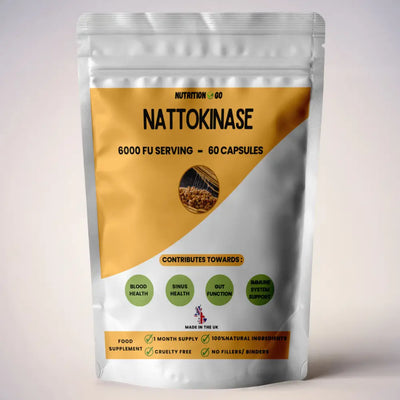
If nattokinase fits your routine, our UK-made 6000FU capsules make daily dosing simple:
How long does nattokinase take to work?
Nattokinase isn't a fast-acting remedy. Most research and practitioner experience suggests:
- First 2–4 weeks: your body is adapting; some people notice subtle changes in energy or circulation.
- 4–8 weeks: the period where most people begin to notice more consistent effects.
- 3 months and beyond: the timeframe for a full assessment of whether nattokinase is working well for you.
Patience and consistency are the foundation — give it a proper trial before drawing conclusions.
The bottom line
The best time to take nattokinase is whichever time you can take it consistently — on an empty stomach, with a full glass of water. Morning and evening both have their merits; what matters most is making it a daily habit and giving it enough time (at least 8 to 12 weeks) to offer meaningful support for your cardiovascular health. As with all supplements, it works best alongside balanced nutrition, regular gentle movement and adequate rest, and it's not a substitute for medical care.
Nattokinase is part of our wider heart-health range:

It also features in our circulation support range:
