


If you're trying to find the best vegan omega 3 supplements UK shoppers can actually buy, the honest starting point is that "vegan" alone doesn't tell you much — some products deliver real algae-sourced EPA and DHA, others lean on ALA from flax or chia that the body converts poorly. This guide breaks down what actually separates a strong option from a weak one, so you can compare properly rather than by front-of-pack claims.
What separates the best vegan omega 3 supplements UK from the rest
Fish don't make omega-3 themselves — they get EPA and DHA by eating microalgae. The best vegan omega 3 supplements UK skip the fish and go straight to that algae source instead, and a 2025 clinical trial found DHA and EPA from microalgal oil were statistically non-inferior to fish oil in raising plasma levels, despite differences in production and composition (Bailey et al., 2025, PMC).
A supplement built only on ALA-rich plant oils — flaxseed, chia, walnut — isn't the same thing. The body converts ALA to EPA and DHA at under 10% efficiency (Burdge & Calder, 2005; Baker et al., 2016), so "omega-3" on the front of the label can mean very different things depending on the actual source.
Vegan omega 3 algae source — what actually matters
Vegans typically run a lower baseline omega-3 index than fish-eaters, and research shows even a modest daily algae-derived EPA/DHA supplement raises that level meaningfully within a few months (Sarter et al., 2015, PubMed). That's the practical reason algae-sourced EPA + DHA content — not just total "omega-3" — is the number worth checking on any label you're comparing.
Which vegan omega 3 supplement should you choose?
Once you're comparing algae-sourced options rather than ALA-only ones, the differences come down to EPA/DHA milligrams per serving, capsule type (HPMC vegetarian vs gelatin), and whether the formula includes anything to support absorption. Black Pepper Extract, for example, has been studied for its role in enhancing nutrient absorption generally, though this isn't an authorised claim specific to omega-3 uptake (Srinivasan, 2007, PubMed).
Vegan omega 3 capsules vs other formats
Vegan omega 3 capsules remain the most practical everyday format — no fishy aftertaste, easy to dose, and simple to take alongside other supplements. If you're specifically looking for vegan algae omega 3 rather than an ALA-only blend, checking the capsule's ingredients panel for "algae" or "algal" is the quickest way to confirm you're getting the right source.
For more on supporting heart health without fish, see our companion guide: Best Time to Take Nattokinase — Morning or Night?. Curious which everyday foods and supplements actually count as vegan sources of omega 3? See our full guide: Vegan Sources of Omega 3: The Complete UK Guide.
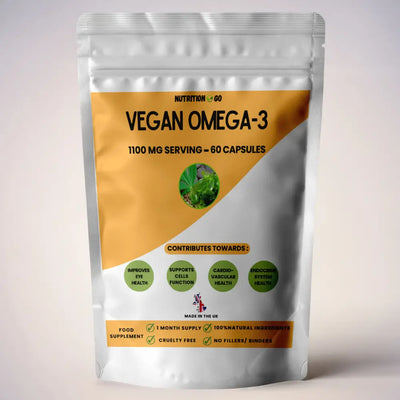
Vegan Omega 3 also sits well alongside our wider range for heart health.

The bottom line
The best vegan omega 3 supplements UK shoppers can buy are the ones that lead with algae-sourced EPA and DHA, state real milligrams per serving rather than a vague "omega-3" figure, and use a genuinely vegetarian capsule shell. Everything else — flavour, price, extras like black pepper — matters less than getting that core source and dose right.
Sources and further reading
- Bailey et al. (2025): Comparative bioavailability of DHA and EPA from microalgal and fish oil in adults — microalgal oil versus fish oil in raising plasma DHA and EPA.
- Burdge GC, Calder PC (2005): Conversion of α-linolenic acid to longer-chain polyunsaturated fatty acids in human adults, Reproduction Nutrition Development.
- Baker EJ et al. (2016): Metabolism and functional effects of plant-derived omega-3 fatty acids in humans, Progress in Lipid Research.
- Sarter B et al. (2015): Blood docosahexaenoic acid and eicosapentaenoic acid in vegans and the effect of an algal-derived omega-3 supplement, Clinical Nutrition.
- Srinivasan K (2007): Black pepper and its pungent principle-piperine: a review of diverse physiological effects, Critical Reviews in Food Science and Nutrition.
- NIH Office of Dietary Supplements: Omega-3 Fatty Acids, Health Professional Fact Sheet — limited ALA conversion, algal oil, and omega-3 and bleeding time.
Food supplements should not be used as a substitute for a varied and balanced diet and a healthy lifestyle.


