

If you're looking for vegan sources of omega 3, the food list is longer than most people expect — but almost none of it contains the two fatty acids that actually matter most: EPA and DHA. This guide covers every genuine vegan source, and why the source you choose changes what you're actually getting.
Plant foods that provide omega-3 (ALA)
Flaxseed, chia seeds, walnuts, hemp seeds and rapeseed oil are the most commonly cited vegan sources of omega 3. All of them provide ALA (alpha-linolenic acid) — an essential fatty acid, but not the same one linked to normal heart, brain and vision function in EU/UK authorised health claims.
The British Dietetic Association names walnuts, flaxseeds and rapeseed oil as particularly good sources of ALA, and also lists soya products for people who don't eat fish. Below is what each food provides, with approximate ALA values per typical serving from the NIH Office of Dietary Supplements food table and USDA FoodData Central. Exact amounts vary by brand, variety and how the food is grown and stored.
Flaxseeds (linseeds): about 2.3g ALA per tablespoon, whole
Flaxseed is one of the richest whole-food vegan sources of omega 3. A tablespoon of whole seeds provides about 2.3g of ALA, and a tablespoon of ground flaxseed provides about 1.6g (NIH ODS; HPRC). Buy it ground, or grind it yourself, because whole seeds often pass through the body undigested. Stir it into porridge, smoothies or yoghurt, and keep ground flax in a sealed container in the fridge.
Flaxseed oil: about 7g ALA per tablespoon
Flaxseed oil is the most concentrated ALA food, at about 7.3g per tablespoon (NIH ODS). It is also delicate: keep it refrigerated in a dark bottle, use it within the date on the label, and never cook with it. Drizzle it over salads, soups or cooked grains once served.
Chia seeds: about 5g ALA per 28g
Chia seeds provide about 5g of ALA per ounce (28g), roughly two tablespoons (NIH ODS). They are easy to use because they do not need grinding. They absorb liquid and thicken into a gel, which makes them ideal for chia pudding, overnight oats or stirring into jam.
Hemp seeds: about 2.6g ALA per 30g (3 tablespoons)
Hulled hemp seeds provide about 2.6g of ALA per 30g, according to USDA data (USDA FoodData Central). They have a mild, nutty flavour and also provide plant protein. Use them hulled and raw, sprinkled over salads, avocado toast or soups.
Walnuts: about 2.6g ALA per 28g (a small handful)
Walnuts are an easy everyday snack and one of the best nut sources of ALA, with about 2.6g of ALA per ounce (NIH ODS). Store them in a cool, dry place so the oils stay fresh, and add them to porridge, salads or baking.
Rapeseed oil: about 1.3g ALA per tablespoon
Rapeseed oil (sold as canola oil in some countries) provides about 1.3g of ALA per tablespoon (NIH ODS). It is a practical everyday cooking oil that copes with gentle heat better than flaxseed oil, so use it for roasting, dressings and light frying.
Soya foods, greens and sea vegetables: small amounts
Frozen edamame provides about 0.3g of ALA per half cup (NIH ODS). That is a modest contribution, but soya foods are also a complete plant protein and easy to eat daily. Leafy greens such as kale and spinach, and seaweeds such as nori, add a little ALA too, but they should not be relied on as a main source.
How much ALA do you need?
The European Food Safety Authority sets an adequate intake for ALA of 0.5% of total energy (European Commission summary of EFSA values), which works out at roughly 1g a day for someone eating 2,000 kcal. The US National Academies' adequate intakes are 1.6g a day for men and 1.1g for women (NIH ODS). One tablespoon of ground flaxseed on your porridge plus a small handful of walnuts gives you roughly 4g of ALA, so it is easy to be comfortably above those reference intakes without changing much about how you eat.
Why ALA isn't the whole picture
The body converts ALA to EPA and DHA at a low rate — under 10% for EPA and lower still for DHA (Burdge & Calder, 2005; Baker et al., 2016). The NIH describes this conversion as very limited, which is why it advises getting EPA and DHA directly from food or supplements to raise their levels in the body. This matters for vegans because people following a vegan diet get almost none of these fats from food (The Vegan Society). In a study of 165 long-term vegans, a 254mg per day algal DHA and EPA supplement raised the omega-3 index from 3.1% to 4.8% over four months in a subset with a low starting level (Sarter et al., 2015, PubMed).
The one vegan source that provides EPA and DHA directly
Algae is the only vegan source of omega 3 that provides EPA and DHA directly, rather than the ALA precursor. Fish don't produce omega-3 themselves — they accumulate it by eating algae — so an algae-sourced supplement is simply going to the source. A 2025 clinical trial found DHA and EPA from microalgal oil were statistically non-inferior to fish oil in raising plasma levels (Bailey et al., 2025, PMC).
Food sources vs supplementing directly
If you eat a wide variety of ALA-rich foods daily, you'll get some conversion — just not much. For most vegans wanting to reach the 250mg EPA+DHA level linked to normal heart function, an algae-sourced supplement is the more reliable route than relying on food conversion alone.

For a full comparison of the algae-sourced options on the UK market, see our guide: Best Vegan Omega 3 Supplements UK.
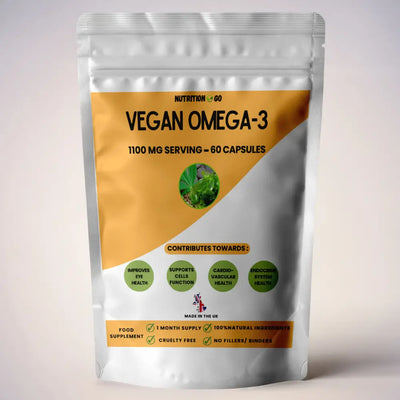
Vegan Omega 3 is part of our wider range for heart health.

The bottom line
Vegan sources of omega 3 exist in plenty of everyday foods, but only algae provides EPA and DHA directly. If you want the same fatty acids fish-eaters get, without relying on inefficient ALA conversion, an algae-sourced vegan omega 3 supplement is the practical way to get there.
Sources and further reading
- NIH Office of Dietary Supplements: Omega-3 Fatty Acids, Health Professional Fact Sheet — food ALA values, adequate intakes and ALA conversion.
- British Dietetic Association: Omega-3 Food Fact Sheet — UK guidance on plant-based omega-3 sources.
- The Vegan Society: Omega-3 fat — practical guidance on ALA-rich foods and microalgae supplements for vegans.
- USDA FoodData Central — nutrient composition database for hemp seeds, soya foods and other foods.
- Human Performance Resource Center: Omega-3 fatty acids in food — ALA per serving for ground flaxseed and other foods.
- European Commission Knowledge4Policy: Dietary recommendations for fat intake — summary of EFSA dietary reference values for ALA.
- Burdge GC, Calder PC (2005): Conversion of α-linolenic acid to longer-chain polyunsaturated fatty acids in human adults, Reproduction Nutrition Development.
- Baker EJ et al. (2016): Metabolism and functional effects of plant-derived omega-3 fatty acids in humans, Progress in Lipid Research.
- Sarter B et al. (2015): Blood DHA and EPA in vegans and the effect of an algal-derived omega-3 supplement, Clinical Nutrition.
- Bailey et al. (2025): Comparative bioavailability of DHA and EPA from microalgal and fish oil in adults.
Food values are approximate and based on typical composition data. Food supplements should not be used as a substitute for a varied and balanced diet and a healthy lifestyle.