

Nattokinase is a powerful enzyme derived from natto — a fermented soya bean dish traditional in Japan. In recent years it has attracted significant interest as a nattokinase supplement for supporting healthy blood flow and cardiovascular function, making it one of the most talked-about heart health supplements available in the UK today. In this guide we cover what a nattokinase supplement does, how much nattokinase per day is recommended, and how to get the best results.
For dosage timing, see our guide: Best Time to Take Nattokinase — Morning or Night?.
What Is Nattokinase?
Nattokinase (NK) is a serine protease enzyme first identified in 1987 by Dr Hiroyuki Sumi at the University of Chicago, who was studying traditional Japanese foods for fibrinolytic — clot-dissolving — activity. He discovered that natto, the sticky fermented soybean food eaten widely in Japan, contained an enzyme of remarkable potency.
Unlike most nutrients consumed in food, nattokinase survives digestion and reaches the bloodstream in active form — where it can influence fibrin, the protein scaffold involved in blood clot formation. A 2024 systematic review and meta-analysis of randomised controlled trials found nattokinase supplementation was associated with favourable changes in several cardiovascular risk markers (systematic review and meta-analysis, PubMed), establishing it as one of the most studied natural enzyme supplements available.
In supplement form, nattokinase is standardised in Fibrinolytic Units (FU) — a measure of enzymatic activity rather than weight. This standardisation is important: it ensures consistent potency from batch to batch, regardless of how the raw material was processed.
What Does a Nattokinase Supplement Do?
Understanding what a nattokinase supplement does requires looking at the fibrinolytic system — the body's natural mechanism for maintaining healthy blood viscosity.
Unlike synthetic blood thinners, nattokinase works by helping the body break down fibrin, a protein involved in blood clot formation. It also stimulates the body's own plasminogen activator system — supporting the natural fibrinolytic process rather than simply suppressing clotting factors.
Supports Healthy Blood Flow and Circulation
By supporting healthy fibrin balance in the bloodstream, nattokinase may help maintain healthy blood viscosity — supporting efficient circulation. A randomised controlled trial published in Hypertension Research found that nattokinase supplementation was associated with reduced blood pressure over an 8-week period in participants with mild hypertension (Kim et al., Hypertension Research, PubMed).
May Support Healthy Blood Pressure Levels
Several clinical trials have investigated nattokinase's effect on blood pressure, with a proposed mechanism involving ACE-inhibiting activity — a pathway also targeted by commonly prescribed blood pressure medications. Nattokinase is a food supplement and should never be used as a substitute for prescribed medication without medical guidance.
Supports Cardiovascular Function
The build-up of fibrin in blood vessels is associated with reduced cardiovascular function over time. By supporting a healthy fibrinolytic balance, nattokinase supports the conditions needed for efficient heart and vascular function — particularly relevant for adults over 40, whose natural plasminogen activator activity tends to decline with age.
Stimulant-Free — No Caffeine, No Synthetic Compounds
Unlike many cardiovascular supplements, nattokinase contains no stimulants, synthetic blood thinners, or pharmaceutical compounds. It's a single enzyme derived from a fermented whole food — suitable for adults who want natural cardiovascular support alongside their normal routine.
How Much Nattokinase Per Day?
The question of how much nattokinase per day is one of the most common questions from new users — and the answer depends on the concentration of the supplement you choose, measured in Fibrinolytic Units (FU).
Clinical research has used doses ranging from 2,000 FU to 10,000 FU per day. The most commonly studied range for general cardiovascular support is 2,000–6,000 FU per day, taken as a single dose:
- 2,000 FU per day — entry-level dose, appropriate for general daily wellness support in healthy adults
- 4,000 FU per day — mid-range dose used in several clinical trials for blood pressure and circulation support
- 6,000 FU per day — highest commonly studied dose, used in trials targeting fibrinogen and blood viscosity
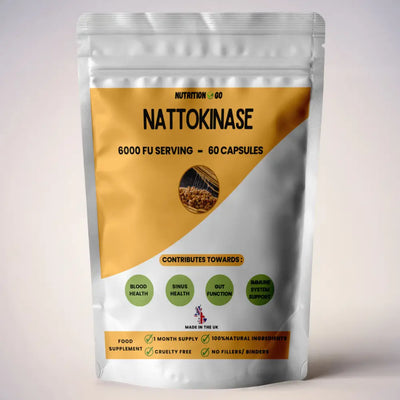
Our NutritionGo nattokinase supplement provides 6,000 FU per serving — the highest commonly studied dose — in a single daily capsule.
Nattokinase Supplement UK — What to Look For When Buying
Not all nattokinase supplements are equal. Here's what to check before buying:
Potency in FU — not milligrams
Always buy nattokinase measured in Fibrinolytic Units (FU), not milligrams. Milligram weight tells you how much powder is in the capsule — it tells you nothing about enzymatic activity.
Minimum 2,000 FU per serving
Products below 2,000 FU per serving are unlikely to provide meaningful fibrinolytic activity based on available research. Look for products clearly labelled with their FU content.
Vegan and free from fillers
Traditional nattokinase is derived from fermented soybeans and is naturally vegan, though some products use gelatin capsules — check the capsule shell material if you follow a plant-based diet.
UK-made with transparent sourcing
Choose a supplement manufactured in a GMP-compliant UK facility with clear ingredient sourcing, as potency can degrade during storage.
Many people also combine a nattokinase supplement with CoQ10 for broader cardiovascular support — CoQ10 helps maintain energy production in heart muscle cells, complementing nattokinase's fibrinolytic action.
Who Should Not Take a Nattokinase Supplement?
Nattokinase is broadly well tolerated by healthy adults but is not suitable for everyone:
- Anyone taking blood thinners — warfarin, aspirin, clopidogrel, heparin or any anticoagulant medication. The combination can increase bleeding risk.
- Anyone scheduled for surgery — stop nattokinase at least 2 weeks before any surgical procedure.
- Pregnant or breastfeeding women — insufficient safety data exists for these groups.
- People with bleeding disorders — including haemophilia or any condition causing abnormal clotting.
- People taking blood pressure medication — nattokinase may lower blood pressure and could interact with antihypertensive drugs.
Nattokinase is part of our wider heart-health and circulation range:

It also fits our circulation support range:
The bottom line
A nattokinase supplement offers a natural, stimulant-free way to support healthy blood flow and cardiovascular function through the body's own fibrinolytic system. Look for a product with a clearly stated FU rating of at least 2,000 FU, check with your GP before combining it with blood-thinning or blood-pressure medication, and give it a consistent 4–8 weeks to assess how it works for you.
